Although I have been using the moonsigns to help guide me through my gardening efforts for over ten years, I am by no means an expert on the subject. In fact, pretty much everything I know comes from the big Historical Weather Chart Calendars that we are given each year around Christmas at the feed store. I have never in my life seen another calendar that provides so much information.
Besides telling you which zodiac sign each day of the year is in, you can also check the distance to plant trees, learn how to fight a fire, count your calories, figure out the quanity of seed used per acre for several dozen crops, and ascertain the amount of silage in silos. And that's just some of what is on the back page. If January 1st rolls around and I don't have my new calendar in hand, I pretty much start to panic.
I probably
would be an expert by now if I'd had the guts to do something more than a one-time rapid flip-through of the copy of
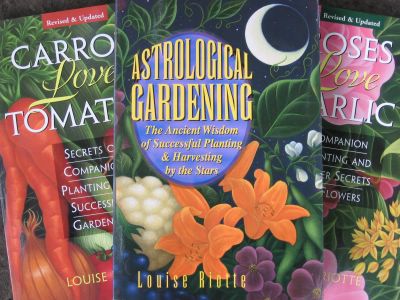
Astrological Gardening: The Ancient Wisdom of Successful Planting & Harvesting by the Stars that has been sitting on my bookshelf for at least a couple of years. But I was already so paranoid about doing things on the wrong day just from what I'd read on my calendar. This was an entire book wanting to tell me when I could (and couldn't) do what. I mean, there are even specific days when you are supposed to water the garden!
But when I started mentioning some of the 'good' moonsign days to start seeds and transplant in my blog posts, several readers became curious and asked me about how this whole minding the moonsign business works. So I gathered up my courage and took down the book. Oh my goodness, it's absolutely crammed with information.
Considering you can buy a copy for about the cost of a couple of packets of seeds, I definitely recommend this book to any gardener interested in improving their gardens (and who isn't?). But before I go any further, I would just like to state two things: 1) Read it at your own mental risk, and 2) If you do read it and become hooked on astrological gardening, you cannot come back and hit me up later for therapy charges because you went berserk trying to do absolutely everything in the garden at precisely the right time.
Now that we have that taken care of, let's get back to the book. Rather than go into everything it covers, I think the best thing to do is simply offer a few excerpts to give you an idea of what the idea behind this book is, and if it seems like it might be something you are interested in learning more about.
I'll start with the note from the author on the back cover that is taken from the introduction:"It is not my intention to argue the merits of 'moon planting' or 'planting by the signs' but rather to set forth as clearly as I can the accumulated wisdom of the centuries regarding astrological gardening. Something that has endured so long must surely have had a reason for coming into being in the first place.
"Astrology is the study and use of the forces of nature as an aid in obtaining the highest possible degree of success. I believe that if you use the advice in this book, you will have a more productive garden, grow more nutritious vegetables and fruits--and your gardening activities will also provide you with a lot of good, clean fun!"
Here is another excerpt from the introduction:"Meanwhile, another biologist, Dr. Lily Kolisko, was conducting experiments of a different sort at the Biological Institute in Stuttgart, Germany. Over a period of ten years, Dr. Kolisko planted many varieties of plants during different moon phases, keeping extensive records not only of the growth of these plants, but also of the taste when the leaves and fruit were picked. (Yes, even the taste can be improved if vegetables and fruits are harvested at the right time. And the nutritive value can also be improved.) [My note: I found these last two points absolutely fascinating.]
"Kolisko found that during the moon's first and second quarters, that is, when it is in its increasing phase, plants yielding above the ground grew especially fast. For example, leafy vegetables such as lettuce, cabbage, celery, and spinach, as well as tomatoes, beans, and cereals all showed superior growth and were better tasting than when sown during the moon's waning phase.
"
Astrology is not really concerned with explaining why the moon has such an important effect on living organisms, only with stating that scientific evidence and subjective experience have proven over and over again that the positions of the planetary bodies, especially the sun and moon, coincide with the natural cycles of all living things. Accepting this statement, the next step is to try to ascertain specifically just what these effects are, so that we can use them to our own advantage, and live in greater harmony with the natural rhythms.
"To do that we have little choice except to fall back on astrological tradition--some of which sounds like pure fantasy, but much of which makes a great deal of good sense. In this book I will try to sort some of this out.
"Here I want to stress an important factor in successful lunar gardening--something only you can provide--that of common sense. Obviously, if your area is having a blizzard when the moon's position indicates the planting of flowers, it is not a good time to plant. The correct lunar position cannot compensate for weather conditions. Weather, temperature, season, and your own personal schedule must also affect your gardening activities."
From Chapter 1: Planting By The Moon's Phase"I realize that most of you do not have the time or desire to study astrology, so I'm going to keep it simple. It isn't necessary to understand why moon planting works; all that gardeners are interested in is the fact that it does work.
"So here's the nitty gritty:
"
During the increasing light (from new moon to full moon), plant annuals that produce their yield above the ground. An annual is a plant that completes its entire life cycle within one growing season, and has to be seeded anew each year. Most vegetables are annuals.
During the decreasing light (from full moon to new foon), plant biennials, perennials, and bulb and root plants."A simple, though less accurate, rule is to plant crops that produce above ground during the increase of the moon, and to plant crops that produce below ground during the decrease of the moon. You can further refine your planting and increase your accuracy by paying attention to which quarter the moon is in." And she then goes on to explain what it is best to do in each quarter."
That last bit was on page 14. The book is over 200 pages long, so you can see that she goes into much greater detail about this whole idea. The book contains an amazing variety of information. Here are just some of the chapter titles: Planting By The Signs, Pest And Disease Control, Understanding Water, Vegetables Can Keep You Fit, Organic Gardening Is A MUST, The Herbal Connection, Teach Your Children, and The Value Of Cell Salts.
Still wondering if it's all a bunch of manure? The author (who also wrote the extremely popular books
Carrots Love Tomatoes: Secrets of Companion Planting For Successful Gardening and
Roses Love Garlic: Companion Planting And Other Secrets Of Flowers, as well as nine others) offers several quotes from scientists regarding astrological gardening and astrology, including this one from the Nobel-prize winning physicist Dr. Robert Millikan, who endorsed the principles involved when answering a question as to the validity of astrology:
"I do know that if man is not affected in some way by the planets, sun and moon, he is the ONLY THING ON EARTH THAT ISN'T." (Caps are the author's.)
I, for one, know that I am now ready to venture further into the astrological garden. At the very least, I want to learn when I should harvest everything for optimum flavor and nutritional value. I know I will no doubt feel a bit overwhelmed at first, but I promise I won't go berserk. You'll have to excuse me now, though, as it is a fertile day in the first quarter, and I really must go plant some beans.
© Copyright FarmgirlFare.com.


